RSS

Category Archives: True Life

EquiNOT

101_3430Dear Spring,

I am writing to you on the happy occasion of the 2013 vernal equinox, and I hope this letter finds you well. I imagine you are busy preparing for your imminent arrival in the UK…aren’t you? We seem to have been left off your itinerary in 2012, and though we waited eagerly to welcome you, we simply watched as winter faded into, well, winter. April came with its showers (and drizzle and downpours and gully-washers) and never actually left–flooded fields all around the village testify to that. There have been one or two rogue days of sunshine in the past eleven months, but never enough of them strung together to resemble anything like a shift to warmer seasons. I searched through more than 700 photos taken during what should have been spring 2012 (20 March-20 June) but alas could only find a single image containing both sunshine and subjects wearing anything less than two jumpers layered under a raincoat (see above). This photo was taken on 28 May, and I had to search a further 800 photos before I could find a “summer” photo that met the same criteria (that one was date stamped 19 August).

I see by the extended forecast that snow is predicted several days next week, so it’s clear you had no intention of arriving as scheduled today. That’s okay…I can understand wanting to be fashionably late. But in my etiquette book, anything later than 1 April is just plain rude. You stood us all up last year, so there are those who loudly proclaim their doubts about your current intentions. I continue to have faith in you though, and even believe that you will come bearing gifts of sunshine, blue skies, and warm temperatures to win back the love lost by last year’s unexcused absence.

Don’t let me down, Spring. This is my last opportunity to experience your pleasant nature on this side of the pond. I’d sure hate to have to go back to the US and perpetuate the ugly rumors that are floating around over there about the weather in the UK…

Sincerely yours,
Michelle


Check!

100_2819

I’ve got a bucket list that I started compiling during college titled, “100 Things To Do Before I Die.” There aren’t actually 100 things on the list yet–at 20, I thought it pretty conceited to presume that I knew enough about life and all the world had to offer to just scribble down a hundred dreams off the cuff. Even now at 40, I’m still reluctant to round out the list. However, one of the items I was sure of, even as a naïve undergrad, was my desire to see the Northern Lights.

We’ve just returned from four nights in Iceland, a trip carefully plotted to fall near the spring equinox because auroral activity typically peaks then (we did not know at the time that NASA had declared 2013 the year to see the Aurora Borealis thanks to a 50-year spike in solar activity). Saturday’s Northern Lights tour, which turned out to be more of a glorified hunt party, was included as part of our holiday package. Four busloads of eager tourists, armed with wide angle lenses and sturdy tripods, set out from Reykjavik at dusk to cap off a day that had been dominated by cloudless crystal blue skies; our local guides were forecasting the most spectacular display of Northern Lights of the season. As we drove away from the city lights, a low bank of clouds gathered over the mountain tops and proceeded to engulf the stars almost as fast as they appeared. Undaunted, and armed with four different meteorological reports that promised clear skies across the entire island, our fearless guides continued on to the night’s pre-selected viewing location in the national park. Gamely, we all tromped off the buses into the biting cold and spent the next hour watching the thickening clouds blot out every last star in the sky. Not ready to give up, our guides herded us back onto the buses with the promise that sources on the south coast were reporting clear skies overhead and we should move quickly to that location. Alas, upon arrival, visibility there was just as poor and the cold was even colder, so around midnight the guides finally admitted defeat and shepherded us back to our hotels, reminding us of the company’s policy to take us out again the next night (and the next, and the next…) until we finally spotted the Aurora Borealis.

Sunday dawned just as bright and cloud-free as Saturday had, so after a day spent paddling around the 100°F waters of the Blue Lagoon to chase away the lingering chill of the previous night, we once again bravely layered on all the clothing we had packed and joined the throngs for another evening of stalking. Our buses headed north out of the capital city under tantalizingly clear skies, and as the miles passed and darkness descended, we watched star after star appear magically in the heavens. Our guide alternated between apologizing for the previous night’s fiasco, disparaging the forecasting and observation skills of the various weather and space authorities the company consults when planning these nightly tours, and meekly offering optimistic promises for the evening’s success. An hour into our 90-minute drive, skies were just dark enough for the first glimmers of the Northern Lights to be visible in the skies ahead of us. The level of excitement (and relief) in the bus ratcheted up with each sighting, and we all tried to pay close attention to the guide’s tutorial on the best camera settings to capture our experience. By the time we finally alit from the bus, the sky was fairly dancing with ribbons of light. It took every last bit of self-control to allow my night vision to become fully functional before running pell-mell up the lava strewn path to claim a spot on the hill for my tripod.

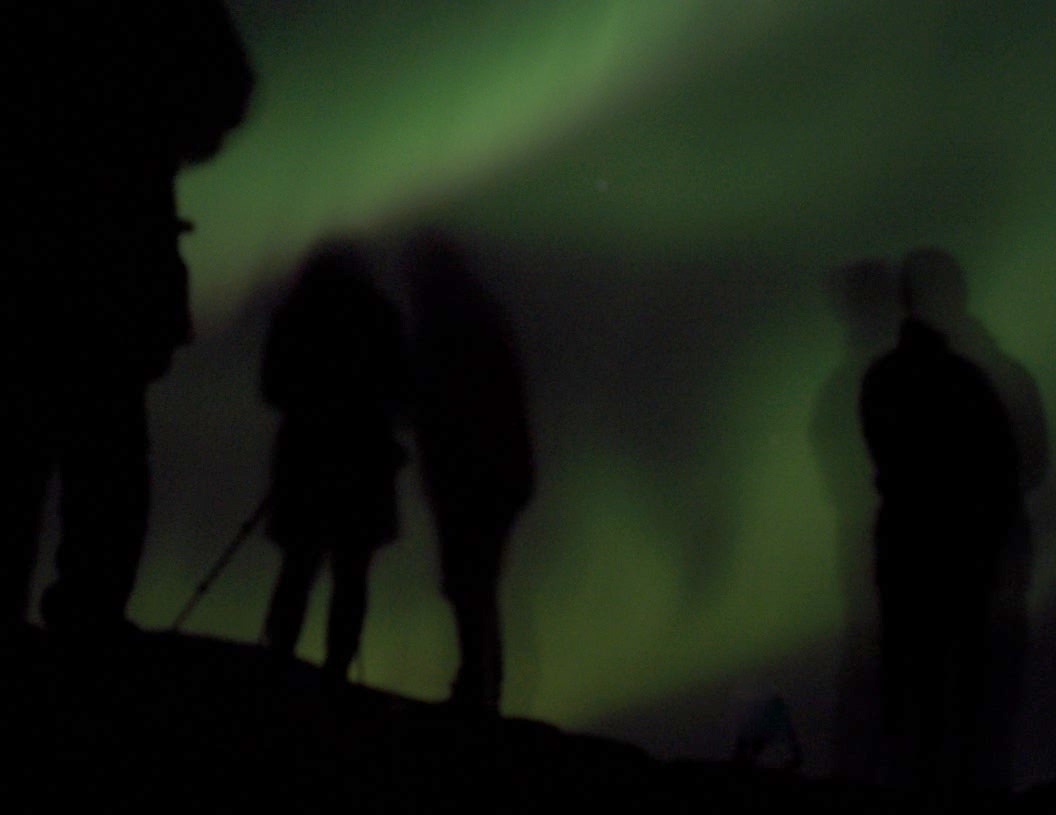
This being only the second time I’ve ever used the manual settings on my trusty and much-loved, but far from professional grade, digital camera, I can’t claim any postcard-worthy shots of the lights (got everything adjusted but the ISO, darn it). While I’ve only got some blurry physical proof that I was there, the entire show is etched indelibly in my mind. Light danced across the sky like the first snowflakes that fall on a cold highway, swirling gracefully across the blacktop in the wake of the car ahead. Ribbons stretched downward into curtains, undulating back and forth like veils in an unseen breeze, their sheer green panels edged in purple and red. More than once, extremely rare (according to our guide) coronas appeared directly above our heads, the shimmering aurora radiating out in all directions from a central halo and occasionally bisected by shooting stars. Light literally flowed across the sky in rivers that brightened and faded, disappearing from the left or behind us and reappearing on the right or in front of us. There was no wrong direction to look, and if my joints had not been so stiff from the cold that I feared not being able to get back up, I would have lain flat on my back on that razor sharp bed of lava in an attempt to take it all in at once.

When the guides finally declared it was time to pack up and head back to Reykjavik, not a single passenger remembered the crushing disappointment or freezing discomfort of the previous night. As our bus headed back to the hotel, our guide was just as ecstatic as we were, assuring us that we had just witnessed the most brilliant display of Northern Lights in Iceland in a full year–high praise from someone who does this every night during the season.

Standing in the check-in line at the airport this morning, strangers offered each other the display screens of their digital cameras, and all of the small talk centered around one burning question. “Did you see the lights last night?”

Check!

 
1 Comment

Posted by on March 18, 2013 in How It Is, Monday Mix, Observations, True Life


Mugshot

100_2834My favorite writing prompt this week comes from The One Minute Writer, and they simply asked if I had a “go-to” mug or cup. This notion is sort of a running joke in my house, so I thought it was worth a response!

For a couple of years now, I’ve teased my husband about only drinking from one coffee cup, day in and day out. It’s not as if we don’t have a dozen sizeable mugs, plus the boring old cups that match the dishes, lined up in the cabinet and ready for use. No, his Starbucks mug is used after dinner every night, filled with water and left in the sink at bedtime, and hand-washed the following afternoon in preparation for its next use (he has no time for coffee before work in the morning, or I’d be hand-washing the cup twice a day). Every other mug we own goes in the dishwasher immediately after use, sits there until the dishwasher fills up, and sometimes doesn’t return to its shelf in the cabinet for a week. The only time my husband’s cup can go in the dishwasher is if all of the following conditions are met: 1) he has finished his evening coffee, 2) the dishwasher is full and ready to be run immediately upon adding the cup to the top rack, and 3) my schedule allows time to unload the clean dishes before the cup is needed again. A few times I tried presenting the evening cuppa joe in a different mug, only to be met with a wounded look and a pitiful, “Where is my cup?” and finally decided it wasn’t worth the guilt trip to avoid hand-washing a single mug. I send up a daily prayer that I not be the one to drop this beloved mug on the unforgiving tile floor…

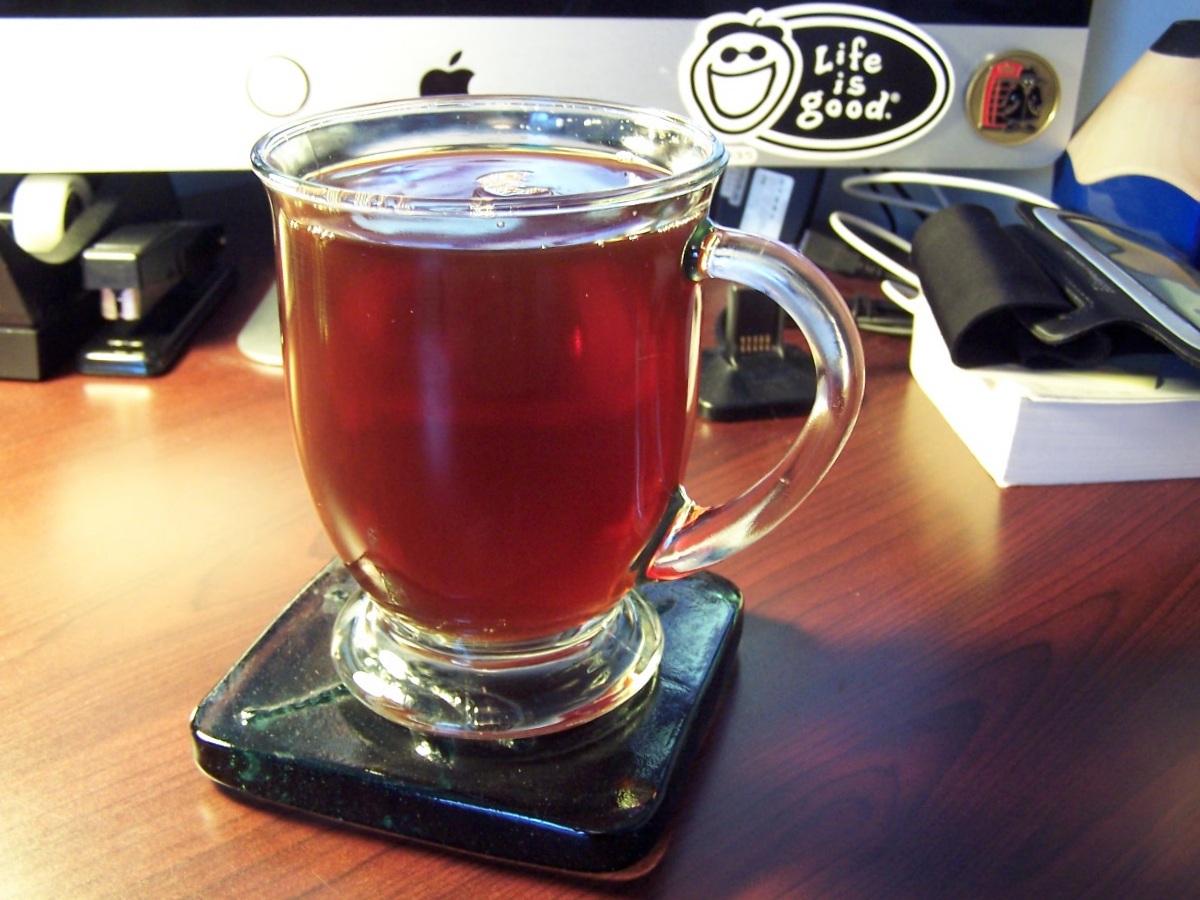
I, on the other hand, couldn’t care less which mug I use for my cup of hot cocoa or herbal tea after dinner. We’ve got an extensive collection of large Starbucks mugs from every Asian city we visited while living in Japan, and I am perfectly happy to just rotate through them, so as not to subject only one or two to excessive trips through the dishwasher. However, this winter I’ve formally adopted the English custom of afternoon tea, usually drunk while I’m trying to dream up a blog post, and I’ve noticed that I habitually reach for one of two plain glass mugs we bought during some move, when our own dishes had not yet arrived and we could no longer tolerate the deprivation we felt drinking from the dainty six-ounce tea cups in the loaner set of tableware. The glass mug is nothing special…just a utilitarian Anchor Hocking mug which can be found on the shelf of any Walmart store in the US. Yet something about this mug is like inviting an old friend for afternoon tea–it’s comforting and familiar, and makes no demands, a perfect foil for the blinking cursor on the screen before me. It’s a heavy mug, with glass thick enough to take an occasional whack without complaint, but well-balanced, with a handle that sits comfortably in my grip. More importantly, there is just enough headroom to make twelve ounces of tea (my preferred volume) and carry it upstairs to my office without spilling along the way.

I’m still happy to use whatever mug I pull down from the cabinet for my evening beverage, but my unpretentious afternoon tea mug now sits in the sink beside my husband’s Starbucks mug, waiting for its daily hand-washing. There is decidedly less teasing on my part, while the prayers for protection from an unfortunate demise on the tile floor have doubled.

 
1 Comment

Posted by on March 17, 2013 in How It Is, Sunday Best, True Life


Tags:

Speechless

100_2794Too old for this new trick

I’m not normally one to back down from an intellectual challenge, but I may have met my match in the Icelandic language. In attempting to skim a magazine or read a menu, nothing about it looks familiar…in Icelandic text I can’t find any words adopted from other languages. According to David, our tour guide today, if the Icelanders need to use a foreign word (think Internet, for example) they will import the meaning, but will create their own new Icelandic word for it. Talk about dedication to not diluting your language!

Here’s what else I gleaned from David’s explanation of the language today (for reference, David is an Englishman who’s been living in Iceland for twelve years–it took him four solid years to learn the language): Icelandic is descended from old Norse languages, as the Vikings were the ones to settle the country. There are 32 letters in the alphabet (including multiple versions of vowels and at least three different characters for the “th” sound) and each one has one and only one very distinct pronunciation. If you saw a “c” in a word (which you wouldn’t, because they don’t have them–they don’t have a “w” either, but they did consent nevertheless to use the internationally accepted WC to let folks know where the toilets are) there would be no confusion about whether it was a hard c or a soft c like in English. When tourists attempt to pronounce Icelandic words (like street names) using the pronunciation rules from their own native language, the Icelanders have no idea what they are saying. Apparently they found great amusement in the world’s news anchors trying in vain to pronounce Eyjafjallajökull, the name of the volcano that erupted in 2010 and practically brought European air travel to a halt for weeks; the American military gave up hope of ever saying it right and dubbed it E15 because it was spelled with an E followed by fifteen other random letters.

Another reason I would hesitate to learn Icelandic is the grammar. Apparently, each noun, pronoun, and adjective has a gender, and is declined in four cases based on that gender, and whether it is singular or plural. (Check out all the ways to spell chicken [underlined] in the above photograph of a Subway menu board.) Verbs are conjugated for tense, mood, person, number, and voice. I’m not sure I know enough about my own English grammar to even know what all those terms mean. The sentence construction is then further affected by whether the person to whom you are speaking is a male or female, young or old. In the end, each word ends up having between 12 and 35 different spellings. That’s a headache I just don’t need at this point in my life.

 
1 Comment

Posted by on March 16, 2013 in How It Is, Observations, True Life


Tags:

Druthers

vacation85As has become my habit on Thursday, I’ve chosen a random question from Gregory Stock’s The Book of Questions to ponder today.

Question 139
Would you rather spend a month on vacation with your parents or put in overtime at your current job for four weeks without extra compensation?

Although I wouldn’t actually mind four weeks of unpaid overtime at any of my four current part-time jobs, this one is a no-brainer. I’d pick the month-long vacation with my parents in a heartbeat. The last family vacation we shared was the summer before I started college–gulp–twenty-three years ago. I had no idea back then that I’d never again enjoy a getaway with Mom and Dad. Sure, I’ve spent time with them since then…I went to their house on weekends, they came to have dinner with me, we spent holidays together. But never again did we all drop everything to go off somewhere and explore a new place in each others’ company.

When I was growing up, we had some wonderful family vacations. Like almost every other American family, we made a pilgrimage to Orlando to meet Mickey and Donald. In a car  with a broken air conditioner, we drove across scorching highways of the midwest to reach the majestic (and blissfully cool) Yellowstone National Park, swinging through Colorado on the way to scale Pike’s Peak and catch a rodeo. We spent a week on the Gulf coast of Texas, where I found my first sand dollar and saw my first waterspout. Some years we’d simply make our way from wherever Dad’s job had us living back to Virginia where grandparents, aunts, uncles, and cousins were based. The week or two we’d spend with extended family was punctuated by outings to Colonial Williamsburg, D.C. museums, and area amusement parks.

Once I moved completely out of my parents’ house after college, I’m not sure they or I ever contemplated the idea of going somewhere together to escape the obligations of day-to-day life and become reacquainted with each other. Then one shocking day in April 2006, my dad died suddenly and any possibility of vacationing with both my parents as an adult died with him. Now that I am married to a man who has both a love of travel and an overseas job that lets us explore lots of new places in our free time, I find myself frequently longing for a chance to share some of these experiences with my parents. I’d love to hear what they think of the people and customs and sights I’ve been lucky enough to see. Even if we didn’t travel to a foreign or exotic location for vacation, I’d love to just have time, away from all the responsibilities that get in the way when you are together at home, to talk to them about their past, my past, our past. To see them relax, to hear them laugh. To thank them for all the vacations of my childhood, and to plot future family get-togethers. I wouldn’t view a month-long vacation with my parents as a choice between the lesser of two evils, as implied in this question. It would be a gift more precious than gold.


Poo

Poo. And I don’t mean Winnie. This is a rather indelicate subject, I’m afraid, but one I encounter often on my walks around the local area. In the UK, dog fouling is a serious issue, as it should be, since there are an estimated 7 million dogs on these islands producing 365,000 tonnes (about 800 million pounds) of feces per year. To ensure walkers aren’t slogging hip-deep through the stuff, most districts have erected disposal stations along sidewalks and footpaths, and enforce fines for those who refuse to scoop the poop. In my district alone, there are several hundred dog bins (I pass at least six on my three-mile circular route around the neighborhood) emptied regularly by a disposal company contracted by the local councils. Across the nation, the minimum fixed fine for dog fouling is £50, but could reach as high as £1000 if the case goes to court. It is interesting to note that fouling offenses and the accompanying penalties do not apply to working dogs or guide dogs. The anti-fouling scheme seems to be working, because not once have I returned home from a walk with dog crap caked in the soles of my shoes.

That does not mean my outings are feces-free; I am constantly dodging road apples in our rural village, and am confused about why there are no horse fouling laws. DEFRA estimates that there are somewhere around one million horses in the UK. While this is less than 15% of the dog population, the beasts are poo machines, letting loose 8 million tonnes (18 billion pounds) of dung annually. Much of this manure falls harmlessly in fields and stalls, posing no hazard to innocent pedestrians, but it only takes one pile of equine excrement to completely ruin a hiker’s high. Horses and walkers share many of the same paths around here, those paths often being the neighborhood roads. Without going into a complicated physics lesson about dung density, vectors, and angular velocity, suffice it to say that poo exiting a moving horse’s backside tends to cover quite a bit of asphalt, unlike the humble dog pile which is delivered from a stationary pose with a much lower trajectory. It’s not always easy or safe to navigate around horse droppings on a single track road where cars are whizzing by at 60mph. So why aren’t horse owners responsible for clearing these minefields for the good of the wider public? Why is there such a doo-doo discrepancy? Why are dog owners persecuted when Fido fouls the footpath, but horse owners ride off into the sunset with impunity when Mr. Ed litters the landscape? I’d look more closely into this issue, but I’m too busy watching where I step.


Shiwase

100_2871-001100_2871-001100_2871-001Today’s post started out as a belated response to last Monday’s Weekly Writing Challenge: Truth Is Stranger Than Fiction over on the Daily Post, in which we were asked to take or find a photograph in which the subject showed true joy, rather than that I’m-smiling-for-the-camera brand of fake happiness. I had bookmarked this photo in my archives last week, but my postings went in other directions and I couldn’t find a day to squeeze this one in. (What?! Too many blogging ideas? Must we start two-a-days?)

The truth behind the photo: I took the original photo (top left) during a visit to Hachimangu Shrine in Kamakura, Japan, in November 2010. I noticed a family feeding the pigeons, and snapped a few random shots in passing, without really stopping to compose the images. It wasn’t until I was back home reviewing the pictures from the day that I noticed that the little boy found it HILARIOUS that his father was covered in pigeons and I wished I’d focused my lens on him rather than just the overriding family scene. I wanted to draw the viewer’s eye to the boy’s shiwase (happiness), so I tried cropping the original shot (top right) to get rid of the empty baby stroller that was on the left side (his younger sister was standing tentatively on her own a few feet away, surrounded by a dozen pigeons), but by trying to keep the same scale, also eliminated the birds around the dad’s feet. I hate creating headless corpses when I edit photos, but in the bottom version the boy is much more the center of attention, although the severity of the cropping has highlighted the fact that he is out of focus. Now I wonder if I’ve removed too much of his body language for the viewer to truly appreciate the extent to which he was enjoying this close encounter of the feathered kind? Other than the obvious advice to be more thoughtful in the way I initially shoot my subject, any feedback on how I should have edited this image to highlight the little guy’s happiness would be appreciated.

Now I veer off the track of the original prompt, and contemplate the contrast between the shiwase in my photograph and the emotion the entire nation of Japan is likely feeling today. March 11, 2013, marks the two-year anniversary of the devastating Tohoku earthquake and its resulting tsunami and nuclear crisis, collectively Japan’s worst disaster since World War II. Some 19,000 victims perished and a further 315,000 either lost or were forced to flee their homes (300,000 are still lodged in temporary housing). I was living in Japan in 2011 (though was vacationing in Hong Kong on the day of the earthquake) and I witnessed firsthand the shock and sadness permeating the whole country as the scope of the tragedy became apparent. Yet almost immediately a wave of compassion, support, and encouragement (ganbatte!) spread across the nation, and survivors showed unbelievable resilience as they pushed through their personal anger, confusion, and heartbreak to work together for the good of their neighbors and communities. Today is surely a somber day for the country, as citizens mourn individuals, families, homes, schools, businesses, and entire towns lost to the catastrophe. But I also know today is a day of renewed hope and determination for the Japanese people, as they are wholeheartedly committed to rebuilding and revitalizing the devastated areas as quickly as possible. To all of those still struggling with loss, I offer wishes for comfort, peace, and hope. To all of those involved in the ongoing recovery efforts, I send prayers for continued guidance, strength, and endurance. Above all, I wish the people of Japan shiwase.


Tags: ,