 Yesterday’s prompt from The Daily Post encouraged bloggers to write about a journey they had taken, either physical or emotional. I’m recycling a post from my Japan blog, in which I described (in detail, so I won’t be offended if you skim) my JOURNEY up and back down Mt. Fuji in August 2009. It was a very physical journey, one that my body paid for dearly (my toenails are still messed up). But it also wrecked then resurrected me emotionally. In hindsight, it was one of the best experiences of my life, teaching me a lot about reaching past my perceived limitations to use every last ounce of physical, mental, and emotional strength to conquer an obstacle.
Mt. Fuji–Day 1
Having been told to expect a three- to four-hour, traffic-snarled drive to Mt. Fuji (being the fourth to last day of the climbing season), the six of us left home in a rented van at 4 a.m. this morning. Only having had about three hours of sleep, all of us should have been groggy and grumpy, yet there was lots of joking and excited chatter as we drove through the brightening dawn towards Mt. Fuji. Even with stops to capture photos of our destination looming ahead in the distance, we made the trip in under two hours. The drive from the base of the mountain to the 5th station, the traditional starting point for climbers, which we were warned would be bumper to bumper, was actually deserted. This meant when we encountered a giant eighth note painted in the middle of the asphalt, we were free to drive the recommended 50 km per hour over the grooved pavement to hear a lovely tune created by the van’s tires.
At last we were directed to park in a fairly empty lot where everyone piled out of the van, slathered on sunscreen, and slung on backpacks. A 10-minute, slightly uphill walk brought us to the famed 5th station of the Kawaguchiko Route, where we took advantage of the foul-smelling, but possibly only, Western-style toilet on the mountain before heading into the gift shop to purchase the requisite Fuji stick. This stick is an octagonal wooden staff, probably worth about $2, but sold for $15. I chose one capped by a flag printed with a map of the trail we were about to climb, but opted not to grab one with bells attached (said to scare away evil spirits along the trail, but more likely to drive the hiker carrying the stick completely insane). The purpose of this stick is not so much to assist climbers over volcanic rocks as it is to offer proof of the journey. At various huts (rest stops) along the trail, the stick can be marked with a red-hot brand for about $3 a pop, with the goal (or at least my goal) being the coveted sunrise stamp at the summit. I know all this because the hubby has a branded stick (with bells!?) from his first ascent of Fuji-san many moons ago. Since that stick is currently in storage, he opted to purchase a regular aluminum hiking pole from a sporting goods store for this second climb. After safely tucking my Fuji-map flag in my backpack so it wouldn’t be ruined by sweaty hands and blowing volcanic dust, I gathered with the rest of the group for a pre-Fuji photo taken by an obliging Japanese climber. Looking at the portrait in the LCD viewer of my camera, we are all smiling, the sky is blue, life couldn’t be better….
As we started out, I was puzzled by the downward slope of the first twenty minutes of hiking. I thought we were climbing up Mt. Fuji? When the path finally became a noticeable, but not unpleasant, incline, we passed by some tired but sturdy looking horses and guides offering $120 rides up the trail. I was lulled into thinking if a horse could go up this trail with a rider on its back, then it should be no problem for me. Fast forward about four hours…The moderate incline has become increasingly steep and I have been climbing as fast as my aching legs will carry me, yet strangely I find myself alone. The rest of the group has deserted me. The gazelles, Patrick, Pat, and Angela, left me in the dust within the first hour. The hubby stayed by my side for a (little) while longer, then started a routine of hiking ahead and waiting for me to catch up at the next hut. Eventually, between the frequent pauses to catch my breath (not really winded from the altitude, just the hard work) and stops to purchase brands for my stick, he gave up and just went on ahead. Aaron was nearby for a longer time, as he was stopping often to take pictures. At some point, I also fell significantly behind him. I was left leap-frogging up the mountain with a Japanese family hiking with their young son, all of us being passed at regular intervals by boisterous twenty-somethings and determined chain-smoking senior citizens.
The Kawaguchiko Route up Mt. Fuji started at an elevation of 2305 m. The path was an interminable series of switchbacks, zigzagging up the mountain. Some sections were wide and covered in soft dust, while other areas were steep, treacherous piles of volcanic boulders that required the use of both hands (notice I did not say Fuji stick) to scale. In some places where the lava from the last eruption cooled too steep and smooth to find a foothold, steps had been carved in the rock. What I didn’t understand was why the rise on each step was between 18 and 24 inches high—that’s a quad-challenging stretch for American-size legs, and must be exceptionally frustrating for the more vertically challenged Japanese. At various points along the trail were randomly spaced “huts” where hikers could rest, purchase drinks and snacks (the price increased with the altitude, but my $2 banana was absolutely delicious), use the toilet for a dollar, and get stamps on their sticks. Our goal for the day was the Fujisan Hotel at the 8th station (3360 m)—and though that was only three stations past our start point, it did not mean my hike was over when I reached the third hut. There were random collections of two to eight huts between each station, and it quickly became depressing trying to figure out how many more huts I needed to pass to reach my goal. No matter how much I climbed, anytime I looked up I only saw more mountain. I finally took some Tylenol to ease the burning in my legs, then just put my head down, put one foot in front of the other, and plodded towards the next hut and its unique stamp—I’m not sure what I would have done without the incentive of filling up my hiking stick with those stamps. I was so determined to have a complete set of stamps (well, minus the one from the unmanned 6th station), in order, that I was outraged when I found out one of the huts around the 7th station was selling the sunrise stamp, and refused to get it because it wouldn’t be authentic unless it was burned into my stick on the summit.
Finally, after about seven and a half hours, I saw a tiny figure waving to me from high above, at what I could only hope was the Fujisan Hotel. It still took another twenty minutes of dragging myself uphill to recognize the figure as my hubby. As I stopped once again to catch my breath, he made his way down the path to escort me the last few meters (consisting of about twenty of those monstrous, quad-punishing lava steps). To my bewilderment, I found myself choking back tears, I guess a result of the tremendous physical and emotional relief of knowing I was finally there.
The Fujisan Hotel was actually nothing more than a large uninsulated wooden shed, with a U-shaped two-tiered bunk layout able to accommodate at least two hundred people stacked like cordwood, but it looked like the Ritz to me. I gladly climbed to my assigned sleeping bag on the top tier bunk, stowed my backpack on a hook, swallowed two more tablets of what would become a long, alternating regimen of Advil and Tylenol, and eased back for a well-deserved rest. Soon dinner was served on a low Japanese table, and I climbed down to my cushion on the floor where I attacked the curry, rice, and hamburger patty with abandon. I was ready to plow through the miniature hot dogs as well, but the first fish-flavored bite brought me sputtering to a halt. After enjoying a $4 hot chocolate served in a 4-ounce Dixie cup, we played some Uno and eavesdropped on the tales of the other hikers who had straggled in. When our tired legs couldn’t stand sitting on the hard floor any longer, we climbed back up to the bunk, stowed the bento breakfasts that were included in our lodging fees, and settled in to get some rest. As I struggled to find a comfortable position for my aching body on the hard bunk, I consoled myself with the fact that I had climbed 1471 vertical meters, and only had 416 to go….
Mt. Fuji–Day 2
The hut operators normally provide a 2:30 a.m. wakeup call so sleepy hikers can heave themselves up the rest of the mountain in time to see the sunrise. However, between the hard bunk, the banging of the bathroom door outside, the arrival of new guests, and the endless parade of overnight hikers stomping past the hut, sleep proved elusive for most of us. Our group finally gave up the charade a little after 1 a.m. and after waking Aaron from a sound sleep, we bundled up in layers, laced up our boots, strapped on our headlamps, and slipped out into the cold to merge with the masses headed up the trail. The climb was rockier and steeper than the day before, and the path was narrower, usually with just enough room for two people to walk side by side. The crowd actually worked to my advantage; it was like bumper to bumper rush hour traffic on I-95, so we were forced to stop every few meters. I could catch my breath without slowing anyone down. The trail got narrower still, forcing us to go single file in some sections. All of the switchbacks made it seem like we were in line for a ride at some particularly sadistic theme park. This was especially frustrating for the hubby, who had energy to spare and desperately wanted to pass the large Japanese tour groups clogging up the path. I simply enjoyed the chance to breathe and look back down the hill at the endless undulating snake of headlamps bobbing in the dark. As time continued to tick away, the increasing strength of the frigid wind and the first hints of brightening skies in the east added an urgency to our efforts to reach the top.
Nearly two and a half hours after leaving the “hotel,” we finally passed through the torii gate marking the shrine perched on the summit of Mt. Fuji. Victory!! All around us were hordes of people milling about, stomping frozen feet, slurping Cup Noodles, and prepping their cameras to catch the perfect shot of the sun’s first peek above the horizon. All I cared about was finding the person who could brand an authentic sunrise stamp into my stick, thereby confirming that I had in fact completed this monumental undertaking. I stood in line behind scores of other people with Fuji sticks, not to get a brand as it turns out, but a disappointing series of kanji characters made by whacking a henna-covered stamp into the side of the stick with a hammer (an admittedly much faster process than branding, which I can kind of understand given the ever-growing line of customers). It left a wet impression that I was warned not to touch (despite the fact that it was placed precisely where I’d been gripping the stick for the entire climb), and looked nothing like the sunrise brand I could have purchased down by the 7th station. Arrggghhh!!
Being fairly drained by the bitter cold winds buffeting us on top of Mt. Fuji, we chose not to take the hour-long walk around the crater rim, therefore missing the actual highest point (directly opposite where we were standing), the weather station, souvenir shops, and Japan’s highest post office. In fact, after a short consultation in which Aaron with his fancy camera was the only dissenting vote, we decided that goraiko, the coming of the light, would be just as impressive from the descending trail as from the summit. So at 4:55 a.m., thirteen minutes shy of the official sunrise, hubby and I got our picture taken at the summit, then turned around and made for the exit.
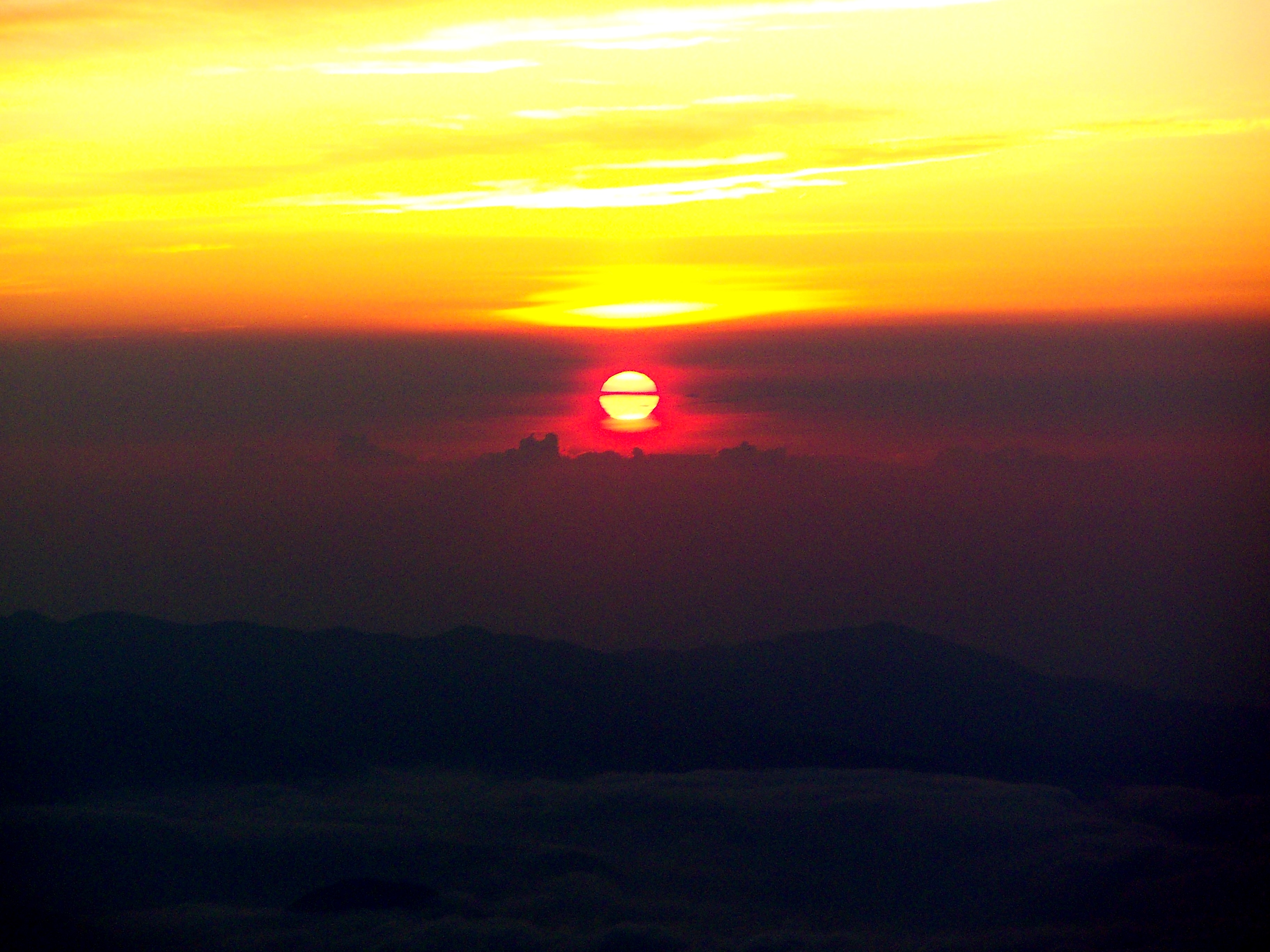
Initially, I was grateful that the descending trail was not the same as the ascending trail—I was not looking forward to scrambling down all those viciously sharp rocks I had just climbed up. The trail started out as a wide, gently sloping path blanketed in thick volcanic dust. Messy but soft, and the easiest way to proceed was just to jog down. I stopped to get pictures of the sunrise along the way, keeping the hubby in my sights ahead of me and Aaron behind me. Before long, the dusty trail became littered with lava rocks, much like you’d find in the bottom of a barbecue grill (shocking to find lava rocks on a volcano, I know) and jogging became less of a viable option. A few rocks scattered half-buried in the dust turned quickly into endless mounds of unstable, shifting, rolling, sliding deathtraps, just waiting for an unsuspecting hiker to make a misstep. Well, before long I did, and down I went, landing flat on my back, my surgically repaired knee bent so my foot touched my butt for the first time in two years, and my camera catching most of my weight on the right side. After verifying that no limbs were broken, I tucked the now useless camera in my backpack, slurped a calming drink of water from the rapidly dwindling supply in my Camelback, and cautiously made my way down around the next bend where I found the hubby waiting. After learning of my fall, he stayed closer to me as I tried with limited success to descend the mine-field of rolling rocks in an upright position. Physically, I had to stop way more often than he would have liked, because my legs just weren’t going to hold me up another step. I ate peanuts, beef jerky, and M&Ms, hoping to get enough of a protein/sugar rush to calm the uncontrollable shaking in my legs. An hour or so into the descent, with nothing in front of us but an endless zigzag of switchbacks covered in treacherous rocks, and an increasingly warm sun blazing overhead, I had drunk all of my water (no one told us there would be nowhere to buy water on the downhill side, or I would have gladly paid $6 a bottle to restock before leaving Fujisan Hotel). Two more falls marked the end of my emotional stamina, and I had to take yet another break on the side of the trail, crying miserably.
Getting no sympathy from the hubby, and noticing that he was becoming increasingly upset with my frequent stops, I urged him to just go on down the hill and meet me at the bottom. He refused, and since Fuji showed no signs of an imminent eruption to put a fiery end to my misery, I was left with no alternative but to suck it up and try to manage a steadier pace. I can’t say the speed improved much over the next hour, but despite some graceless, lunging slips, there were no more falls, which slightly improved my emotional state. After a call from Patrick (yes, DOCOMO cell phones work on Fuji), who had already reached the bottom and was waiting with Pat and Angela at the 5th station, we determined that we were about an hour from being done with this whole mess. Getting ever more thirsty and trembly, each downward step was sheer agony, and the Fuji stick was finally put to good use. With the hubby supporting me on one side, and the Fuji stick on the other, we made it to the point where the ascending and descending trails merge, and scenery began to look familiar—almost there. We passed the horses we’d seen on the way up (I refused to pay $120 to ride one the rest of the way down, mainly because I didn’t think there was any way in hell my legs were going to let me climb up on the back of one), where we received another call from Patrick wondering where we were. Apparently still about 30 minutes away, so I begged him to please buy us bottled water and Aquarius sports drink to have the second we walked off the trail. He also mentioned that Aaron had made it to the bottom. Really? He didn’t pass us. Hmm. Apparently, he had taken the wrong fork in the descending trail, and ended up on the other side of the mountain. Not wanting to embark on a three hour drive to pick him up, Pat told him to find the train station, and we’d see him at home.
Remember I mentioned when we started our climb yesterday that we were initially going downhill? I thought going back up that section would really suck on the return trip, hikers being tired and all. Never in my life have I been so glad to walk uphill. The gradual incline took the pressure off the screaming muscles in my thighs and calves, my toes were no longer jammed up against the inside of my boots, and as I saw the corner of the 5th station buildings peeking over the treetops ahead of us, I was able to hobble faster to the end of this miserable journey. We passed dozens of people who were just starting out, looking fresh and clean, and as excited as we had been yesterday—I figured seeing my bedraggled condition would discourage some of them, but they continued happily on their way. Finally catching sight of Patrick walking toward us with dewy bottles of water in his hands brought a fresh round of tears, this time a combination of exhaustion, gratitude, relief, pain, and even a bit of elation at having conquered Mt. Fuji. After a short rest and guzzling two bottles of much-needed liquid, the five remaining members of our party struck out for the parking lot and the waiting van which would carry us off that blasted mountain. Save for a revitalizing stop to chow down at McDonalds, the ride home was decidedly more quiet than yesterday’s journey.
Back at home, hubby and I rolled out of the van and went inside to face the menacing staircase separating us from the hot shower that we hoped would soothe aching muscles and wash off the gritty film of volcanic dust. Afterwards, a nap and cocktail of Advil and Tylenol didn’t do much to ease the soreness, so I endured an agonizing climb back down the stairs to soak in the tub. Still not finding much relief, I resigned myself to another night with little rest.
Before succumbing to sleep, Jim and I rehashed our Fuji adventure once again–the good, the bad, and the ugly. Despite the agony, I am happy (or will be) that I did not miss the opportunity to climb Mt. Fuji while we were in Japan. I don’t think I’ll be tackling Everest, and I have certainly abandoned our hare-brained, pre-climb scheme to go back to Fuji next year and start from the very bottom. If they ever offer cable car or helicopter rides down from the summit, I might be convinced to climb up Mt. Fuji again (after all, I never did get my coveted sunrise stamp), but the devil will be wearing a fur-lined parka before I ever agree to walk/slide/fall back down that hellacious pile of rock.






 Things I See and Know