
RSS

Category Archives: Deep Thought Thursday

Beef

Moo

Question 73
Would you be willing to go to a slaughterhouse and kill a cow? Do you eat meat?

No, and yes. There. Am I done? Can I go now?

Dr. Gregory Stock makes sure there’s no moral dilemma left untouched in The Book of Questions. I don’t like this question, because I’m not sure what it says about my character.

I knowingly and willingly kill flies, spiders (unless they are Daddy Longlegs), and mosquitoes. I have, on two different occasions, passively murdered mice. The one that died by poisoning took her last breath in the middle of my living room floor (my dad swore to me it would eat the D-Con then run outside and die while it was searching for water and I’d never see it), and I cried for an hour thinking of the babies I had orphaned. The second one got caught in a trap at work, but the trap had not humanely broken the mouse’s neck, and I had to club it to end its suffering. Cried about two hours, plus had nightmares, after that one. I used to fish with my grandfather, and finally stopped trying to revive the bass and bream by mouth-to-mouth once I realized I was going to have to fillet them whether they were still flopping about or not.

But even though I am technically a serial killer, there is no way on this earth I could kill a cow. Or a pig. Or a chicken. I don’t have any good reasons for being selectively homicidal. I don’t believe animals and insects that are small or don’t meet the classic ideal of cuteness have any less right to life than other creatures. If I had endless hours in the day, I would probably catch the flies that bang themselves senseless against the third floor windows and the spiders that drop from my ceilings like Marines rappelling from a Blackhawk, then turn them all loose outside (like I do with moths and ladybugs). I have switched to live traps on the rare occasions when I can hear a mouse scrabbling about in the walls. And my husband’s refusal to eat fish has converted me to a catch and release angler. Slowly but surely I am reforming my murderous ways, although the flies and mosquitoes will probably never be able to stop looking over their shoulders.

I have always said that if I had grown up on a farm, I would be a vegetarian. Not only would I not be able to slaughter an animal myself, I wouldn’t be able to stand knowing someone I loved was doing it either. But I didn’t grow up on a farm, and I eat meat. It doesn’t bother me in the least to let some faceless butcher in a distant city do the dirty work so I can throw a steak on the grill. Buying beef from a refrigerated case is cold (no pun intended) and impersonal. All I’m looking for is the package with the leanest cuts and the smallest bones. My brain does not wander to what this creature looked like on the hoof, with its velvety nose and long-lashed brown eyes. I don’t allow myself to think what its life might have been like, good or bad, neither lush green pastures nor dirty, crowded feedlots. My head is firmly in the sand…I see a plastic-wrapped styrofoam tray of meat, nothing more, nothing less.

I feel very conflicted about this attitude…if I am not willing to kill a cow myself for food, why am I not morally opposed to someone else killing it for me? Killing is killing. I feel that somehow I am a hypocrite, although I realize I am in the company of millions of like-minded carnivores. I guess the easiest thing to do is just carry on not thinking about where the meat I’m buying has come from and not worrying about the ethics of the whole situation. Now, if you’ll excuse me, I think I’ll go throw a beef stir fry in the pan, because all of this deep thought is making me hungry.
 

1%

HPIM1696It’s Thoughtful Thursday, and time for another random question from The Book of Questions by Gregory Stock, PhD.

Question 5
If a new medicine were developed that would cure arthritis but cause a fatal reaction in 1 percent of those who took it, would you want it to be released to the public?

Funny that Dr. Stock has chosen arthritis for this question. I happen to have rheumatoid arthritis (RA), which is an autoimmune disease that causes my body to attack its own joints. I was diagnosed in 1994, two months after my college graduation. At first, the symptoms were mild—a couple stiff fingers, a slight twinge when I rotated my wrist, a vague feeling of fluid in my knees. I had a pretty physical job at the time, so I chalked it all up to overuse, took a couple Advil, and carried on. Within a couple weeks I was popping four Advil every two hours to just barely take the edge off the pain and swelling that were wreaking havoc with my fingers, wrists, elbows, knees, and ankles. I knew there was something more than overuse to blame, so made an appointment at a medical office where a PA told me I had a virus and should drink plenty of water. I suffered another week before going back for a follow-up, barely able to get into the car on the day of my appointment because I couldn’t bend knees swollen to the size of volleyballs or turn the key in the ignition without tears of pain streaming down my face. Finally, a blood test earned me a referral to a rheumatologist who diagnosed RA and started me on a cocktail of side effect-laden drugs.

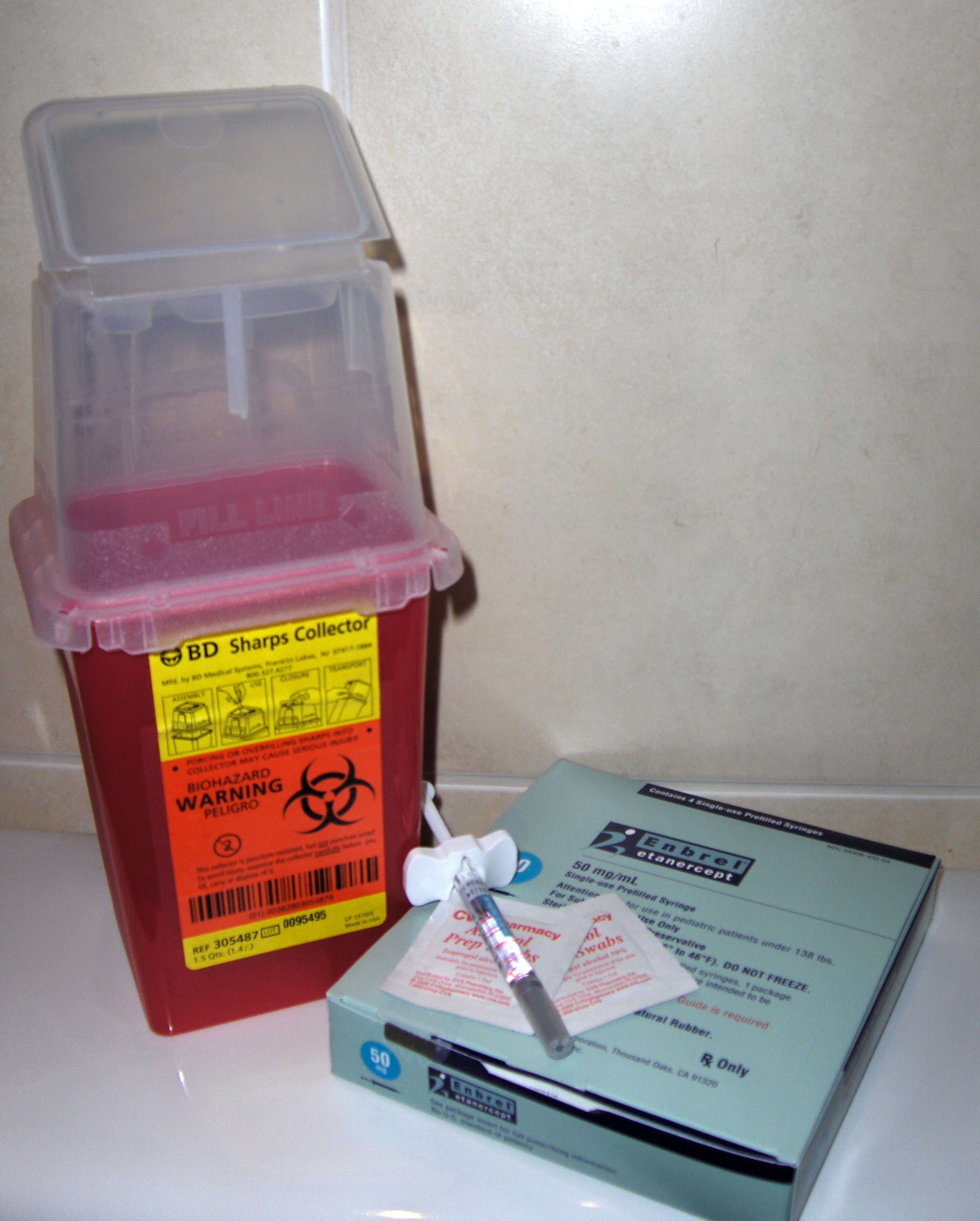
I was lucky. Prednisone (a steroid known to cause osteoporosis with long-term use) is GREAT stuff, and eliminated the pain and swelling in my joints within about 30 minutes of my return from the pharmacy. It continued to work its magic for several months while the long-term regimen of Ansaid (a nonsteroidal anti-inflammatory drug known to cause intestinal bleeding), Plaquenil (a disease modifying antirheumatic drug known to cause eye damage), and methotrexate (a chemotherapy agent known to cause liver damage) had time to build up in my system and suppress my immune system. Within six months, I looked and felt like a normal human being again, so I was happy to overlook any and all possible long-term side effects. Coming off the prednisone was a long, arduous process, but in about eighteen months I was finally able to do it. For the next twelve years, I continued on the Ansaid, Plaquenil, and methotrexate, and was doing so well that my rheumatologist believed I was in remission and encouraged me to begin weaning myself off all of those medications. I was drug-free for nearly a year before symptoms began to reappear, and I gradually added back all of the old medications, ramping up to and surpassing my previous dosages to try to control the flare. When it became obvious that the old drugs were no longer working, my rheumatologist started me on self-injected Enbrel, a TNF inhibitor that is one of the new biopharmaceuticals designed to treat autoimmune diseases. Again, I was lucky, and as soon as the Enbrel kicked in, I was able to eliminate all of the other medications once more. I’m now symptom-free as long as I continue my weekly (or biweekly if I’m feeling really good) injections. The trade-off is that treatment with Enbrel means I have an increased risk of developing a serious infection that could lead to hospitalization or death, and also a “several-fold” increase in the risk of developing lymphoma compared to the general population.

So, back to the question. I am interpreting it to mean that a single treatment would cure the arthritis—gone, completely and forever—with no side effects to worry about down the road, and that for the unfortunate 1 percent, death would come immediately after taking the medication. Therefore, I say absolutely, release it to the public. I’d be first in line to take it. For me, the one in a hundred chance of immediate (and I’m also assuming quick and painless here) death is a small worry compared to wondering every time I inject myself if this’ll be the dose that kicks off some horrible infection or lymphoma. A quick death as one of the 1 percent doesn’t sound as terrible as a long, agonizing, and ultimately unsuccessful battle against infection or cancer. And the other 99 percent, some of whom have likely not experienced the same success in eliminating their symptoms as I have, would have their lives back. They could once again take a walk, open a door, wrestle on the floor with their children or their pets, play the piano or the fiddle or the saxophone, twist off the cap of a cold beer, knit a sweater, assemble IKEA furniture, cut up their own steak, hold a toothbrush, run up the stairs, dig in the garden, button their jeans, turn on a lamp, tie their shoes…


Druthers

vacation85As has become my habit on Thursday, I’ve chosen a random question from Gregory Stock’s The Book of Questions to ponder today.

Question 139
Would you rather spend a month on vacation with your parents or put in overtime at your current job for four weeks without extra compensation?

Although I wouldn’t actually mind four weeks of unpaid overtime at any of my four current part-time jobs, this one is a no-brainer. I’d pick the month-long vacation with my parents in a heartbeat. The last family vacation we shared was the summer before I started college–gulp–twenty-three years ago. I had no idea back then that I’d never again enjoy a getaway with Mom and Dad. Sure, I’ve spent time with them since then…I went to their house on weekends, they came to have dinner with me, we spent holidays together. But never again did we all drop everything to go off somewhere and explore a new place in each others’ company.

When I was growing up, we had some wonderful family vacations. Like almost every other American family, we made a pilgrimage to Orlando to meet Mickey and Donald. In a car  with a broken air conditioner, we drove across scorching highways of the midwest to reach the majestic (and blissfully cool) Yellowstone National Park, swinging through Colorado on the way to scale Pike’s Peak and catch a rodeo. We spent a week on the Gulf coast of Texas, where I found my first sand dollar and saw my first waterspout. Some years we’d simply make our way from wherever Dad’s job had us living back to Virginia where grandparents, aunts, uncles, and cousins were based. The week or two we’d spend with extended family was punctuated by outings to Colonial Williamsburg, D.C. museums, and area amusement parks.

Once I moved completely out of my parents’ house after college, I’m not sure they or I ever contemplated the idea of going somewhere together to escape the obligations of day-to-day life and become reacquainted with each other. Then one shocking day in April 2006, my dad died suddenly and any possibility of vacationing with both my parents as an adult died with him. Now that I am married to a man who has both a love of travel and an overseas job that lets us explore lots of new places in our free time, I find myself frequently longing for a chance to share some of these experiences with my parents. I’d love to hear what they think of the people and customs and sights I’ve been lucky enough to see. Even if we didn’t travel to a foreign or exotic location for vacation, I’d love to just have time, away from all the responsibilities that get in the way when you are together at home, to talk to them about their past, my past, our past. To see them relax, to hear them laugh. To thank them for all the vacations of my childhood, and to plot future family get-togethers. I wouldn’t view a month-long vacation with my parents as a choice between the lesser of two evils, as implied in this question. It would be a gift more precious than gold.


Perjury

101_0026My inaugural attempt at Thoughtful Tuesdays morphed into Deep Thought Thursdays when I laid out my official blogging map last week, but the premise remains the same. I have randomly selected a question from Gregory Stock, PhD’s The Book of Questions, available online.

Question 202
Would you be willing to commit perjury for a close friend? For example, might you testify that he was driving carefully when he hit a pedestrian even though he had been joking around and not paying attention?

Short answer: no. I would not commit perjury for a close friend, or even a family member.

I have lots of friendly acquaintances, but by choice, I have very few close friends simply because I believe true friendships require energy, attention, and maintenance. That makes it sound like friendship is a job, and that’s not at all what I mean. But I don’t think it’s fair to call someone my friend if I am not willing to invest in the relationship to make it strong and lasting. I never really stopped to think about it before, but in my mind, I guess I take my friendships as seriously as my marriage vows. My close friends are like blood relatives to me, and can count on my love, devotion, and loyalty in good times and bad. But I will not sacrifice my values for anyone, and if I’ve chosen my friends as wisely as I think I have, they would never ask me to do so. I like to think that my honesty and integrity are integral qualities of my character that make others amenable to claiming me as a friend in the first place. If I were willing to surrender them so easily, I would not be able to respect myself, much less ask anyone else to respect me. Lying in such a serious situation might save one friend initially, but as it would cost me my self-worth and potentially ruin other friendships and relationships if word of my dishonesty got out, resentment would build and the friendship would die anyway. The price of perjury would be too dear, one I am not willing to pay.

So, fair warning my friends (and family members). If you hit a pedestrian, I will not lie for you. You can, however, count on me to visit you in jail, to make sure your family is okay while you’re incarcerated, and to bring you a nice outfit to wear home on your release day. I expect you’d do exactly the same for me.

 
1 Comment

Posted by on March 7, 2013 in Deep Thought Thursday, How It Is, On Me