 No sooner had the bells finished ushering the last of the faithful through the oaken door into St. Mary’s than the men who revered the gospels of Remington, Winchester, Smith, and Wesson lifted their arms in praise. The wind blew in from the southwest, transmitting the rifle reports of the Sunday morning gun club clearly across the stubbly winter fields, the sharp tattoo echoing off the stone cottages as I walked through the empty lanes of our quaint little village. Randall stumbled to a surprised halt when I stepped from behind the shadowed arc of the bridge onto the towpath directly in front of him; Daisy had not sent up her usual baying alarm because she had not scented a stranger as the twosome ambled along the deserted canal. His face and fists began to clench with rage when he realized that I was not in the kitchen fixing the “full English” he had commanded as he clomped out the door, and I couldn’t help but wonder once more how a man so tender and patient with the witless, intractable beagle straining at the end of leash could berate, belittle, and beat his own wife so mercilessly without the slightest provocation. With one swift, sure movement of my gloved hand, I swung the tiny revolver from my jacket pocket and pressed its muzzle to his heart, the solitary crack of its discharge a declaration of freedom, yet an indistinguishable voice in the weekly chorus of the gun club’s riflemen. Noticing a sudden lack of tension in the lead against which she constantly tugged, Daisy took off through the hedges, nose to the ground, hot on the trail of some unseen rabbit or fox, the racket she made crashing through the underbrush nearly disguising the splash of Randall’s limp body as it toppled into the murky water of the canal and obscured the concentric rings of ripples where my discarded revolver had sunk.
Author Archives: dreaminofobx
Freedom
Roots
 I like to think of myself like the little cactus I bought at an antique fair last year (it’s not an antique cactus, just a sideline business of one of the vendors). The stallholder said, “Don’t worry if part of that falls off on the way home, just stick it in some dirt and it’ll be fine.” Sure enough, part of the cactus did fall off, and I stuck it down in the dirt right next to the mother plant, where it is now outpacing the growth of its progenitor.
I’ve never been securely planted in any one place in my whole life. I was born in a little Ohio town, and left there when I was five, so I’ve never felt I could claim it as a hometown. Moving with my father’s job every couple of years until high school made it nearly impossible to put down roots. There was always a new assignment to knock our family loose, and we’d need to be stuck down in the dirt in a new location. I didn’t know it at the time, but I was growing stronger each time I was replanted.
As an adult, I haven’t done much better at clinging to a single patch of earth. I married a man whose job offers opportunity for travel, and despite my transient youth, I was eager for him to apply for overseas positions. We’re a few months away from moving for the fourth time in seven years—a statistic that looks bad on paper, but has been such a blessing for my personal growth.
As a child, I envied my schoolmates who had lived in the same town, even in the same house, their whole lives, whose grandparents were within an hour’s drive, and who were certain that when they went off to college, got married, had their own families, they’d always know where home was. At the time, I couldn’t appreciate that having to put down shallow roots time and time again was actually giving me more stability than my deep-rooted friends. From my adult perspective, most of the people I know who have always been firmly entrenched in one place are sometimes narrow-minded, often intimidated by change, and hesitant to acknowledge or accept progress. I can now see that constantly moving and having to reestablish myself in new locations has enabled me to view the world from a broader and more open perspective, to adapt quickly to new surroundings and conditions, and to generally just go with the flow.
My mom used to have a fridge magnet which I resented with every fiber of my youthful being; it said simply, “Bloom where you are planted.” Every time I poured a glass of milk, I felt like those words were mocking our rootless family and my childhood misery over yet another relocation. But today, as I am once again thriving in new dirt, I see the wisdom in the magnet’s message, and follow its command without an ounce of regret or resentment.
Today’s post was a five-minute (okay, closer to 15 because I just can’t give up the editing and revising part) free-write inspired by the Five Minute Friday section of Lisa-Jo Baker’s blog. I cheated even more by not writing on today’s topic (Afraid) and choosing one from November.
Defiance

Don’t tell me I can’t, because I can.
Don’t tell me I am unrealistic, because I believe anything is possible.
Don’t tell me I shouldn’t, because I need to learn from my own experience.
Don’t tell me I am a failure, because I grow more determined by not succeeding.
Don’t tell me I can’t, because I will.
Haven
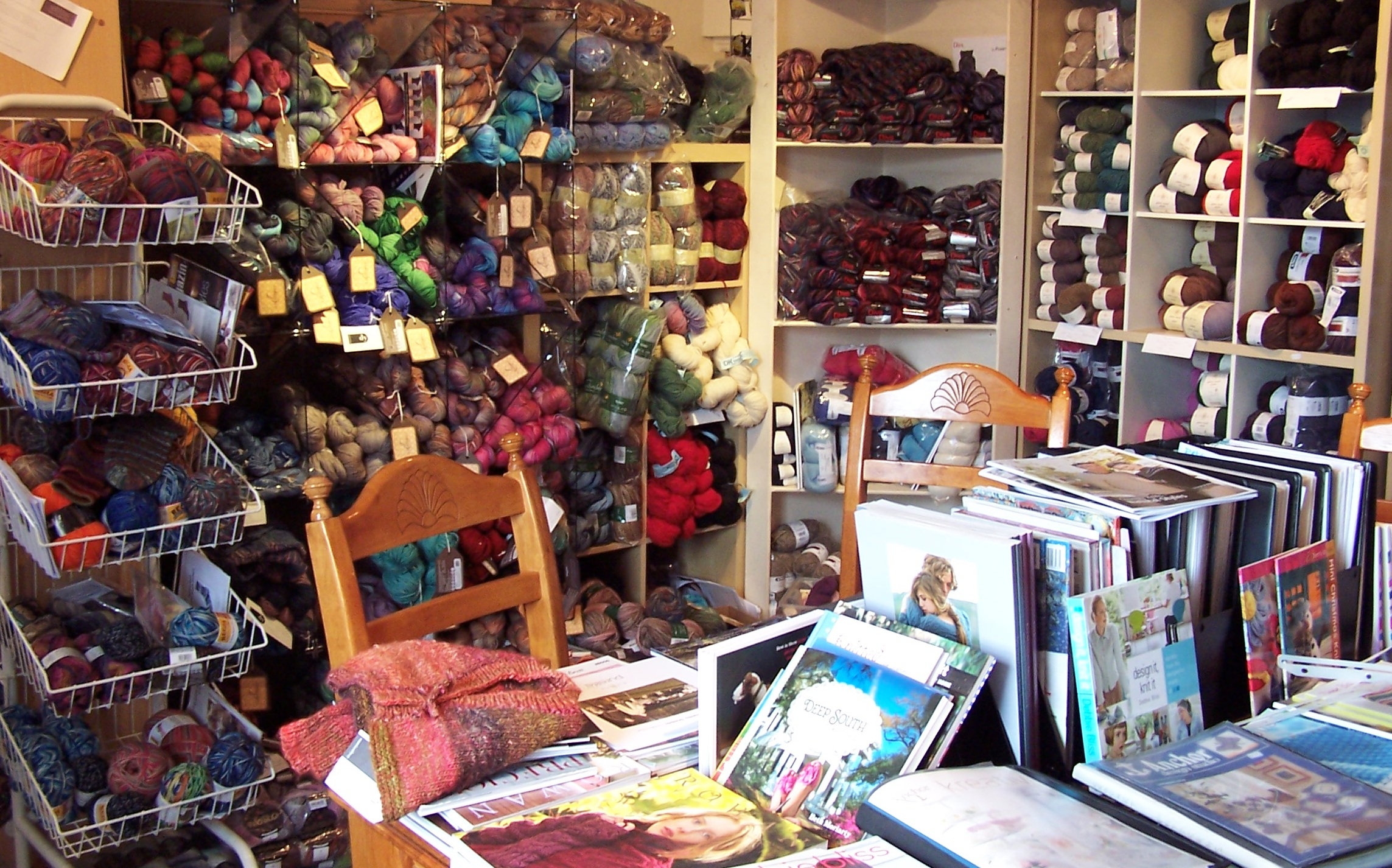 I don’t know what you call the female version of the man-cave, but in my house it will look something like this. One whole wall will be dedicated to a lattice of floor-to-ceiling bins stuffed with skeins of yarn in every color, texture, and weight imaginable. Even if I never get around to crocheting it all into afghans, throws, scarves, or socks, the yarn itself will be art, a kind of woolly 3-D wallpaper that will embrace me as soon as I enter the room.
Opposite the yarn, an old pine farm table will be shoved up against the wall below a wide leaded glass window. I could go for an easy-to-clean, tilt-in double-hung sash window, but I love the pattern of elongated hexagons balanced between tipped up squares. The morning light will spill through the beveled panes and tickle the yarn wall, teasing out colors that can’t be seen in the artificial glare of CFL in the ceiling fixture. The honey-colored pine table is solid, the pegged joints of the understructure showing no signs of loosening despite its age. It’s been well-used, some might say abused, during its long life, the top a motif of dings and water rings, one of its legs a victim of some mischievous terrier. Next to the paperback with the feather sticking out to mark my place, I’ll have an electric kettle and my favorite mug on one of my mom’s quilted placemats, because I do love a spot of tea. There will be a couple of baskets on the table, catching pens, sticky notes, crochet hooks, and any little items that have found their way into the room but don’t have a proper home.
Connecting the yarn and window walls will be built-in cases filled with my favorite books. Some will be pattern books so I can justify the need for all that yarn, several will be antique leather-bound classics that make me look well-read but are, in fact, just for decoration, and the rest will be books I’ve read and loved or have collected in anticipation of loving. A couple of framed family photos will peek out between the spines, and knick-knacks will perch along the shelves—beach rocks, glass insulators, and an army of turtles.
There will be a fireplace near the door on the last wall, into which I can toss a three-hour fire log on a gloomy day to ward off the chill. On the hand-hewn oak beam that serves as a mantle, the faithful tick-tock of the clock will be the heartbeat of the room, a constant, comforting companion. The hardwood floor in front of the fire will be covered by a rag rug, which cushions the runners of my wooden rocking chair. My greyhound and my cat love to curl up together on the rug, their sleepy eyes tracking my movements as I put the kettle on and exchange a half-finished afghan in favor of a half-finished novel.
This room will be my haven, far from the responsibilities in the kitchen and laundry room, the siren call of the television in the living room, or the accusatory glare of the blank computer screen in the office. Visitors will be welcome, as long as they check all foul moods, harsh words, unkind thoughts, and argumentative inclinations at the door. In this room, I’ll be channeling Jason Mraz: peace in my mind, peace in my heart, peace in my soul.
Pie

If you are on the Atkins Diet, England is not the place for you. It is my theory that dreary weather drives people to crave carbohydrates, and I blame the fact that 2012 was the wettest (i.e. greyest and gloomiest) year on record for the fact that I am now participating in the gym’s “Biggest Loser” weight loss challenge. The Brits do comfort food really well—porridge, crumpets, bacon baps, pasties, jacket potatoes with all kinds of toppings, chips (big, fat hand-cut French fries—the ones made from Maris Piper potatoes are the best), mac and cheese (with a side of chips), and oh, yes, pies (think potpie, not apple pie–with a side of chips).
You haven’t had a British pie until you’ve been to Puddingface at the Crown & Tuns in Deddington. The pies are huge and homemade, so the selection changes daily based on what’s available from the local suppliers. The menu is listed on a chalkboard near the bar, and it’s often difficult to choose just one from the range of ten to fifteen pies. Is it a sausage and bacon kind of night, or perhaps turkey with sage stuffing, or traditional English steak and kidney (uh, no thanks)? The chef will happily cater to vegetarians, but Atkins dieters should just stay home—there’s really no lesser of two evils when you have to choose between short crust or puff pastry. Carbophobics also have to make a dreadful decision on side dishes between a basket of chips or a crock of mashed potatoes.
Tonight I ate a “chicken and mushroom with white wine, double cream, and parsley” pie, and I finished every last flaky crumb. I also managed at least one potato’s worth of chips, with malt vinegar, and topped it all off with a couple chunks of carrots and parsnips, because people on a diet are supposed to eat vegetables. I didn’t have the warm chocolate fudge cake with ice cream, not because I wasn’t tempted, but because there was just no…more…room. The button on my fat jeans is straining, so I’m sure I’ve just undone all the progress I’d made at last week’s weigh in, but my days here in England are numbered, and sometimes you’ve just got to say, “Calories be damned, carpe pie!”
January
 January was as cold as the month for which she had been named. After six months of torture at the hands of a sadistic teenaged boy, the mutilated, emaciated kitten was tossed behind the dumpster of the Chinese take-away, where the weeknight delivery guy valiantly rescued her from the bitter winter night, ignoring her attempts to maim him with tooth and claw. In the years since joining the young man’s household, January had done nothing to repay his kindness, pinning her ears and stalking out of the room whenever he entered, hissing and spitting if he or his new bride reached a hand to pet her, shredding the entire perimeter of the cherished antique carpet they’d fought hard to win in the online auction. January’s savior and his wife had grown accustomed to her irascible disposition, sheepishly warning visitors to steer clear of the cat, but steadfastly believing their patience and love would eventually melt the ice around her heart. Now, with an ill-advised swipe of her claws across the flawless ivory cheek of the pink-wrapped bundle that had been ceaselessly wailing since its arrival two weeks ago, she had found the limits of their devotion to her. Banished to the garden on a frosty afternoon, January was left to ponder whether her ruthlessly defended desire for solitude in the household had just become a lifetime sentence of solitary confinement outside its walls.
Today’s challenge was taken from the 9 January prompt on storyaday.org The instructions were to write a January story in six sentences–how I chose to incorporate January was left entirely to me.
Travellers
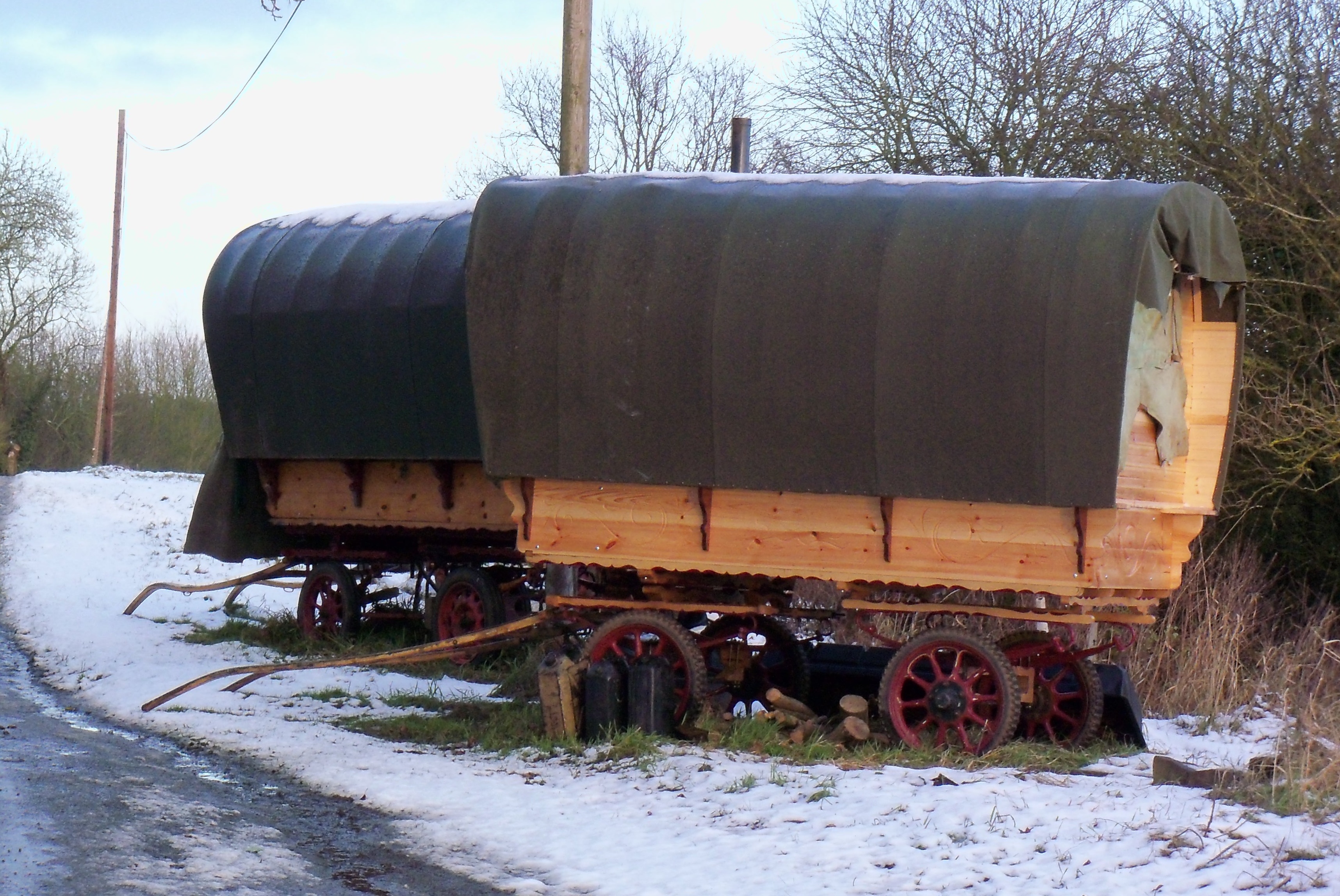
A long time ago, I told Jim I’d happily live anywhere with him, even if it was in a cardboard box on a street corner. What I was trying to say is that he is my home, and the shelter in which we actually reside just doesn’t matter so long as he’s with me. While I still mean every word of that sentiment, I look at these gypsy wagons and think that a life moving constantly from place to place in a horse-drawn wooden barrel might not be so good for our relationship. I am fairly adaptable to most situations and would love the opportunity to see the countryside at such a relaxed pace, but I tend to get cranky when I’m cold or if I have to go more than about 24 hours without a hot shower.
Travellers can refer to either of two nomadic ethnic minority groups legally recognized by the British government–Romani Gypsies or Irish Travellers. There are no reliable statistics for the number of Travellers in the UK, but based on a 2006 census of local caravan counts, the government estimates the population at about 300,000. The Gypsies have been living in the UK since the 1500s, and their origins have been traced to India (hence the famous dark complexions in gypsy stories). On the other hand, Irish Travellers came to England from Ireland in the 1800s to escape the potato famine. Both groups have a history of self-employment, and moving from place to place in order to find work. Today, the traditional horse-drawn wagons have been replaced in many cases by SUV-towed campers with more modern conveniences, but the idea is the same. Many Travellers are not on the go year-round…there are semi-permanent Traveller communities all around the country, some sanctioned by the local councils and some illegally established which causes bad blood between the Travellers and the locals. Often, the mother and children will stay in one place while the father travels to find work, yet Traveller children have the poorest school attendance records of any ethnic minority group in the UK. Travellers inspire a mixture of curiosity, fear, romance, and hatred among “settled people,” as their history, culture, and lifestyle are often misunderstood; in fact, Travellers are often the target of prejudice that no other ethnic or racial group would tolerate (try substituting “blacks” or “Mexicans” instead of “travellers” in this actual news headline: “Winning the war against travellers”). Jake Bowers, one of Britain’s only Romani journalists, has written an online learning guide that explores the facts and debunks the myths about this interesting sector of British society.


 Things I See and Know